Why most crypto products have terrible positioning
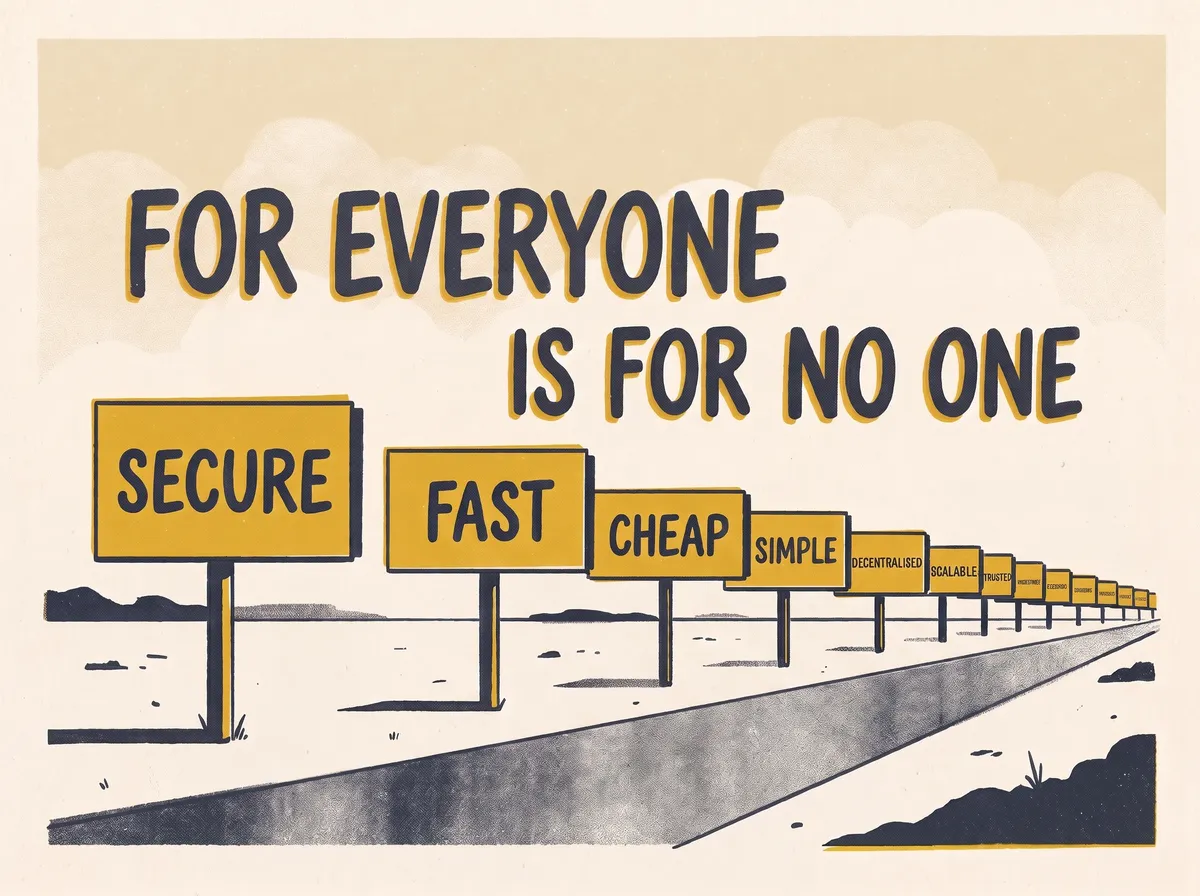
Read ten crypto homepages back to back, from a chain, an exchange, a wallet and a lending protocol, and you’ll find the same promise in different fonts, usually some version of faster, cheaper and more secure, for everyone.
Underneath it sits the same grid of a throughput number, a count of supported assets, an audit badge, a “trusted by millions” line and a wall of partner logos, and you could swap the brand names around without anyone noticing.
Most teams treat this as a copy problem and hire someone to write a sharper headline. A headline can only express a decision that already exists, though, and these homepages are what you get when nobody made one.
”For everyone” means nobody decided
Positioning comes down to deciding who the story is built for and why those people should pick you over what they already use. Copy comes after both decisions. When a team skips those choices, the copy has nothing to express, so it falls back on the widest possible claim and a list of everything the product has.
The audience list gives it away. Builders, traders, institutions, newcomers, power users and “the next billion users” are all real groups, but a list of everyone who could use your product describes a sales territory and says nothing about which problem you solve unusually well or what you replace.
The related failure is a product that can’t say which category it belongs to. If a reader can’t tell within a few seconds whether you’re a chain, an app, a wallet, a super-app or an “onchain operating system”, every feature you add to the description makes the answer harder to find.
Bull markets and incentives hide bad positioning
Crypto gets away with this for longer than most industries because it has two machines that manufacture demand whatever your positioning says.
The first is the market cycle. In a bull run demand is undifferentiated, and the new users who arrive with rising prices pick whatever is trending or first in the app store. Every homepage converts and every launch looks like a success, so strong and weak positioning produce roughly the same dashboard.
The second is incentives. Points programs, liquidity mining, airdrop campaigns and trading competitions all buy usage directly, deposits and active addresses climb, and the team concludes that the story is working. Then the token launches or the emissions end and a large share of that activity often leaves within weeks. All incentives can tell you is that people showed up when they were paid to.
Both machines eventually stop, and when they do the only users left are the ones who had a specific reason to be there. That is when you learn whether your positioning ever gave anyone one.

The moments that test positioning in this industry tend to be exchange collapses, fee spikes, exploits and depegs. When Celsius froze withdrawals in 2022 and FTX imploded within a week a few months later, millions of people suddenly wanted to know where their assets were and who controlled them. Products that had already decided to answer that question were ready for them, and the ones positioned for everyone had to improvise.
One product, three reasons to use it
Picture one crypto app and three people opening it for the first time.
The first is buying their first bitcoin and wants to know whether the app is legitimate and what happens if they get something wrong.
The second trades every day, already knows how all of this works and cares about spreads, execution, limits and whether the app holds up when the market moves fast.
The third wants to send dollars to family abroad using a stablecoin, and their question is whether the money arrives in a form the other person can use, for less than they pay today.
A homepage that tries to answer all three first questions at once answers each of them badly. The same happens when a chain courts developers and liquidity providers with a single message, or when a protocol pitches retail and institutions in the same sentence.

Choosing a primary audience still leaves room for the others. It means deciding whose first question the main story answers and then building deliberate paths for everyone else through separate pages, onboarding flows, guides and launch angles, with the same product and a different emphasis for each.
Seven words that do no work
Secure, fast, cheap, simple, decentralised, scalable and trusted all describe something real, and so many companies use them that they no longer carry information. When every new chain advertises fees under a cent and near-instant confirmation, fast and cheap become the price of entry to the category.
A useful test is to delete your logo and read the homepage again. If a competitor could publish it unchanged, you haven’t positioned anything yet. A differentiator is a specific difference that matters to a specific audience and that you can demonstrate, whether it comes from the technology, a workflow, the business model or a trade-off you made on purpose. Security claims fail this test more often than any other.
Positioning is a product decision
A positioning statement that only lives in a doc does very little. Its job is to tell the company what to build next and, just as often, what to leave out.
It also makes promises the product has to keep. If you position for newcomers and then ask them on the second screen to pick a network and hold a separate token for fees, the product has contradicted the homepage. If you position around decentralisation while a small group can still upgrade the contracts overnight, someone will point it out in public with a link.
Clear positioning surfaces those conflicts early, while they are still cheap to fix. When the positioning is “for everyone”, every feature request looks on strategy and the roadmap fills up with things that please someone and differentiate nothing.
Three questions to answer before anyone writes a headline
- Whose first question does the main story answer? Describe the situation that brings them to you, for example someone who has just watched their exchange freeze withdrawals.
- What do they use today? Usually it’s a banking app, a centralised exchange, a chain where their liquidity already sits, or nothing at all.
- What can you demonstrate that matters to them? Focus on what you can prove for this particular audience.
Most teams stall on the first question, usually because two audiences look equally attractive. The tie-breaker I’d use is to pick the audience whose first question your product already answers better than their current alternative does, and where you can prove it today. The other audience still gets a deliberate path, and it can move into the main story once the product and the evidence catch up.
A copywriter can’t answer these alone, because the answers need the people who own the product and the people who own the numbers in the same room.
Choosing has a cost
Narrowing the story will cost you something. Some prospects won’t see themselves in the main message, and in a hot market a sharper story can mean slightly fewer sign-ups for a while. Internal teams whose segment lost its place on the homepage will push back too. Some of the people it turns away will be the ones who only came for the airdrop, which is worth remembering when the numbers dip.
Not choosing costs more, and the bill arrives later. It shows up when the cycle turns and the incentives end, as a brand nobody can describe and a roadmap that can’t say no to anything.
If your positioning could describe every competitor in the category, a new headline won’t help, because the problem sits in the decision behind it.